











Related Articles Featuring Dr.
Antell
If you're
considering abdominoplasty...
Abdominoplasty, known more commonly as a "tummy
tuck," is a major sugical procedure to remove
excess skin and fat from the middle and lower abdominal
and to tighten the muscles of the abdomen wall.
The procedure can dramatically reduce the appearance
of a protruding abdomen. But bear in mind, it does
produce a permanent scar, which, depending on the
extent of the original problem and the surgery required
to correct it, can extend from hip to hip.
If you're considering abdominoplasty, this will
give you a basic understanding of the procedure
- when it can help, how it's performed, and what
results you can expect. It can't answer all of your
questions, since a lot depends on the individual
patient and the surgeon. Please ask your surgeon
about anything you don't understand.
[Back to abdominoplasty list]
The best
candidates for abdominoplasty
The best candidates for abdominoplasty are men
or women who are in relatively good shape but are
bothered by a large fat deposit or loose abdominal
skin that won't respond to diet or exercise. The
surgery is particularly helpful to women who, through
multiple pregnancies, have stretched their abdominal
muscles and skin beyond the point where they can
return to normal. Loss of skin elasticity in older
patients, which frequently occurs with slight obesity
or extensive weight loss can also be improved.
Abdominoplasty can enhance your appearance and
your self-confidence, but it won't necessarily change
your looks to match your ideal, or cause other people
to treat you differently. Before you decide to have
surgery, think carefully about your expectations
and discuss them with your surgeon.
[Back to abdominoplasty list]
All plastic
surgery carries some uncertainty and risk
Thousands of abdominoplasties are performed successfully
each year. When done by a qualified plastic surgeon
who is trained in body contouring, the results are
generally quite positive. Nevertheless, there are
always risks associated with surgery and specific
complications associated with this procedure.
Post-operative complications such as infection and
blood clots are rare, but can occur. Infection can
be treated with drainage and antibiotics. You can
minimize the risk of blood clots by moving around
as soon after the surgery as possible.
Poor healing, which results in conspicuous scars,
may necessitate a second operation. Smokers should
be advised to stop, as smoking may increase the
risk of complications and delay healing.
You can reduce your risk of complications by closely
following your surgeon's instructions before and
after the surgery, especially with regard to when
and how you should resume physical activity.
[Back to abdominoplasty list]
Planning
your surgery
In your initial consultation, your surgeon will
evaluate your health, determine the extent of fat
deposits in your abdominal region, and carefully
assess your skin tone. Be sure to tell your surgeon
if you smoke, and if you're taking any medications,
vitamins, or other drugs.
Be frank in discussing your expectations with your
surgeon. He or she should be equally frank with
you, describing your alternatives and the risks
and limitations of each.
If, for example, your fat deposits are limited to
the area below the navel, you may require a less
complex procedure called a partial abdominoplasty,
also know as a mini-tummy tuck. You may, on the
other hand, benefit more from partial or complete
abdominoplasty done in conjunction with liposuction
to remove fat deposits from the hips, for a better
body contour. Or maybe liposuction alone would create
the best result.
In any case, your surgeon should work with you to
recommend the procedure that is right for you and
will come closest to producing the desired body
contour.
During the consultation, your surgeon should also
explain the anesthesia he or she will use, the type
of facility where the surgery will be performed,
and the costs involved. In most cases, health insurance
policies do not cover the cost of abdominoplasty.
[Back to abdominoplasty list]
Preparing
for your surgery
Your surgeon will give you specific instructions
on how to prepare for surgery, including guidelines
on eating and drinking, smoking, and taking or avoiding
certain vitamins, and medications.
If you smoke, plan to quit at least one to two weeks
before your surgery and not to resume for at least
two weeks after your surgery. Avoid overexposure
to the sun before surgery, especially to your abdomen,
and do not go on a stringent diet, as both can inhibit
your ability to heal. If you develop a cold or infection
of any kind, your surgery will probably be postponed.
Whether your surgery is done on an outpatient or
inpatient basis, you should arrange for someone
to drive you home after your surgery, and to help
you out for a day or two.
[Back to abdominoplasty list]
Where
your surgery will be performed
Many surgeons perform both partial and complete
abdominoplasties in an outpatient surgical center
or an ambulatory surgery facility.
[Back to abdominoplasty list]
Types
of anesthesia for abdominoplasty
Your doctor may select general anesthesia, so you'll
sleep through the operation. Other surgeons use
local anesthesia, combined with a sedative to make
you drowsy.
[Back to abdominoplasty list]
The surgery
Complete abdominoplasty usually takes two to five
hours, depending on the extent of work required.
Partial abdominoplasty may take an hour or two.
An incision just above the pubic area is used
to remove excess skin and fat from the middle
and lower abdomen.
Most commonly, the surgeon will make a long incision
from hipbone to hipbone, just above the pubic area.
A second incision is made to free the navel from
surrounding tissue. With partial abdominoplasty,
the incision is much shorter and the navel may not
be moved, although it may be pulled into an unnatural
shape as the skin is tightened and stitched.
Skin is separated from the abdominal wall all
the way up to the ribs.
Next, the surgeon separates the skin from the abdominal
wall all the way up to your ribs and lifts a large
skin flap to reveal the vertical muscles in your
abdomen. These muscles are tightened by pulling
them close together and stitching them into their
new position. This provides a firmer abdominal wall
and narrows the waistline.
The surgeon draws underlying muscle and tissue
together and stitches them, thereby narrowing
the waistline and strengthening the abdominal
wall.
The skin flap is then stretched down and the extra
skin is removed. A new hole is cut for your navel,
which is then stitched in place. Finally, the incisions
will be stitched, dressings will be applied, and
a temporary tube may be inserted to drain excess
fluid from the surgical site.
Abdominal skin is drawn down and excess is
removed. With complete abdominoplasty, a
new opening is cut for the navel. Both
incisions are stitched closed.
In partial abdominoplasty, the skin is separated
only between the incision line and the navel. This
skin flap is stretched down, the excess is removed,
and the flap is stitched back into place.
[Back to abdominoplasty list]
After
your surgery
For the first few days, your abdomen will probably
be swollen and you're likely to feel some pain and
discomfort which can be controlled by medication.
Your doctor will give you instructions for showering
and changing your dressings.
Surface stitches will be removed in five to seven
days. The dressing on your incision may be replaced
by a support garment.
[Back to abdominoplasty list]
Getting
back to normal after abdominoplasty
It may take you weeks to feel like your old self
again. If you start out in top physical condition
with strong abdominal muscles, recovery from abdominoplasty
will be much faster. Most people return to work
after two weeks.
Exercise will help you heal better. Even people
who have never exercised before should begin an
exercise program to reduce swelling, lower the chance
of blood clots, and tone muscles. Vigorous exercise,
however, should be avoided until you can do it comfortably.
Your scars may actually appear to worsen during
the first three to six months as they heal, but
this is normal. Expect it to take nine months to
a year before your scars flatten out and lighten
in color. While they'll never disappear completely,
abdominal scars will not show under most clothing,
even under bathing suits.
[Back to abdominoplasty list]
Your
new look after abdominoplasty
Abdominoplasty, whether partial or complete, produces
excellent results for patients with weakened abdominal
muscles or excess skin. And in most cases, the results
are long lasting, if you follow a balanced diet
and exercise regularly.
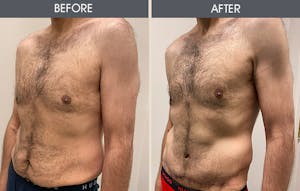
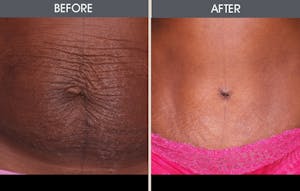
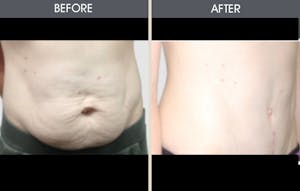
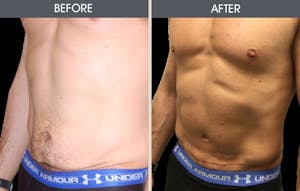
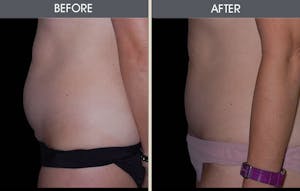
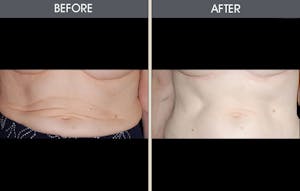
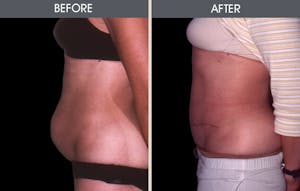
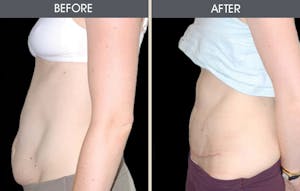
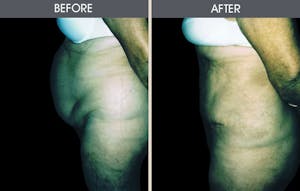
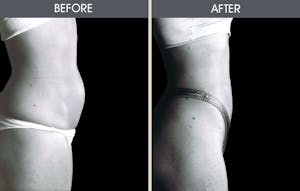
After surgery, the patient has a flatter,
trimmer abdomen. Scars are permanent, but will
fade with time.
If you're realistic in your expectations and prepared
for the consequences of a permanent scar. Abdominoplasty
may be just the answer for you.
[Back to abdominoplasty list]
© Copyright American Society of Plastic Surgeons
If you would like to contact New York plastic surgeon
Darrick Antell, or if have any further questions about
abdominoplasty (tummy tuck) or any of our plastic
surgery procedures, please use our contact
form.